Beachley Furniture: Unified Project Financials Across NetSuite, Paycom, and Monday.com
The Challenge
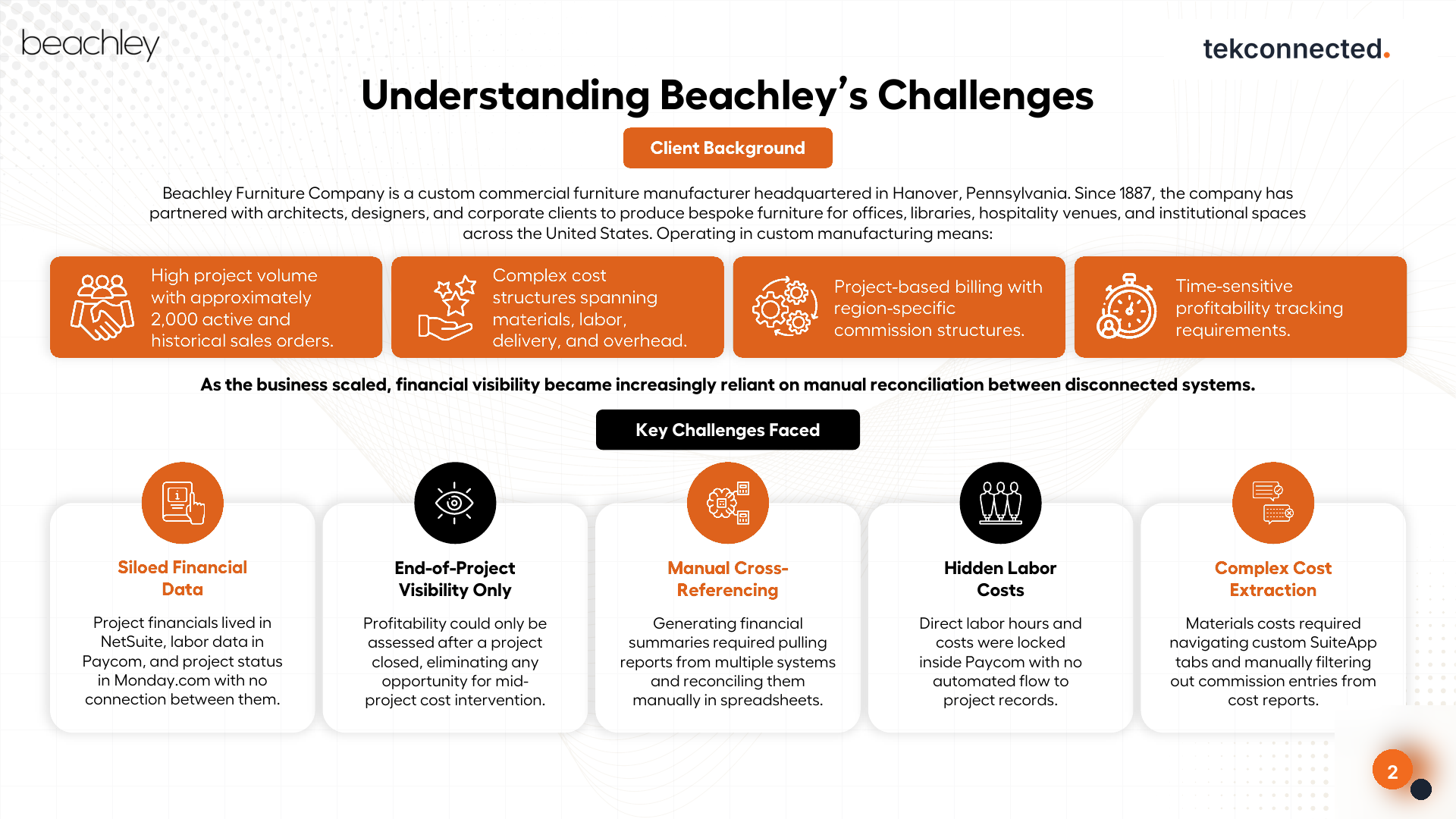
Project financials at Beachley lived in NetSuite, labor data in Paycom, and project status in Monday.com with no connection between them. Profitability could only be assessed after a project closed, eliminating any opportunity for mid-project cost intervention.
Beachley Furniture Company is a custom commercial furniture manufacturer headquartered in Hanover, Pennsylvania. Since 1887 the company has partnered with architects, designers, and corporate clients to produce bespoke furniture for offices, libraries, hospitality venues, and institutional spaces across the United States. As the business scaled, financial visibility became increasingly reliant on manual reconciliation between disconnected systems.
What Operating in Custom Manufacturing Means
- High project volume with approximately 2,000 active and historical sales orders
- Complex cost structures spanning materials, labor, delivery, and overhead
- Project-based billing with region-specific commission structures
- Time-sensitive profitability tracking requirements
Key Challenges Faced
- Manual Financial Consolidation
- Generating financial summaries required pulling reports from multiple systems and reconciling them manually in spreadsheets.
- Hidden Labor Costs
- Direct labor hours and costs were locked inside Paycom with no automated flow to project records.
- Complex Materials Cost Extraction
- Materials costs required navigating custom SuiteApp tabs and manually filtering out commission entries from cost reports.
- No Real-Time Profitability
- Profitability could only be assessed after a project closed, eliminating any opportunity for mid-project cost intervention.
The Solution
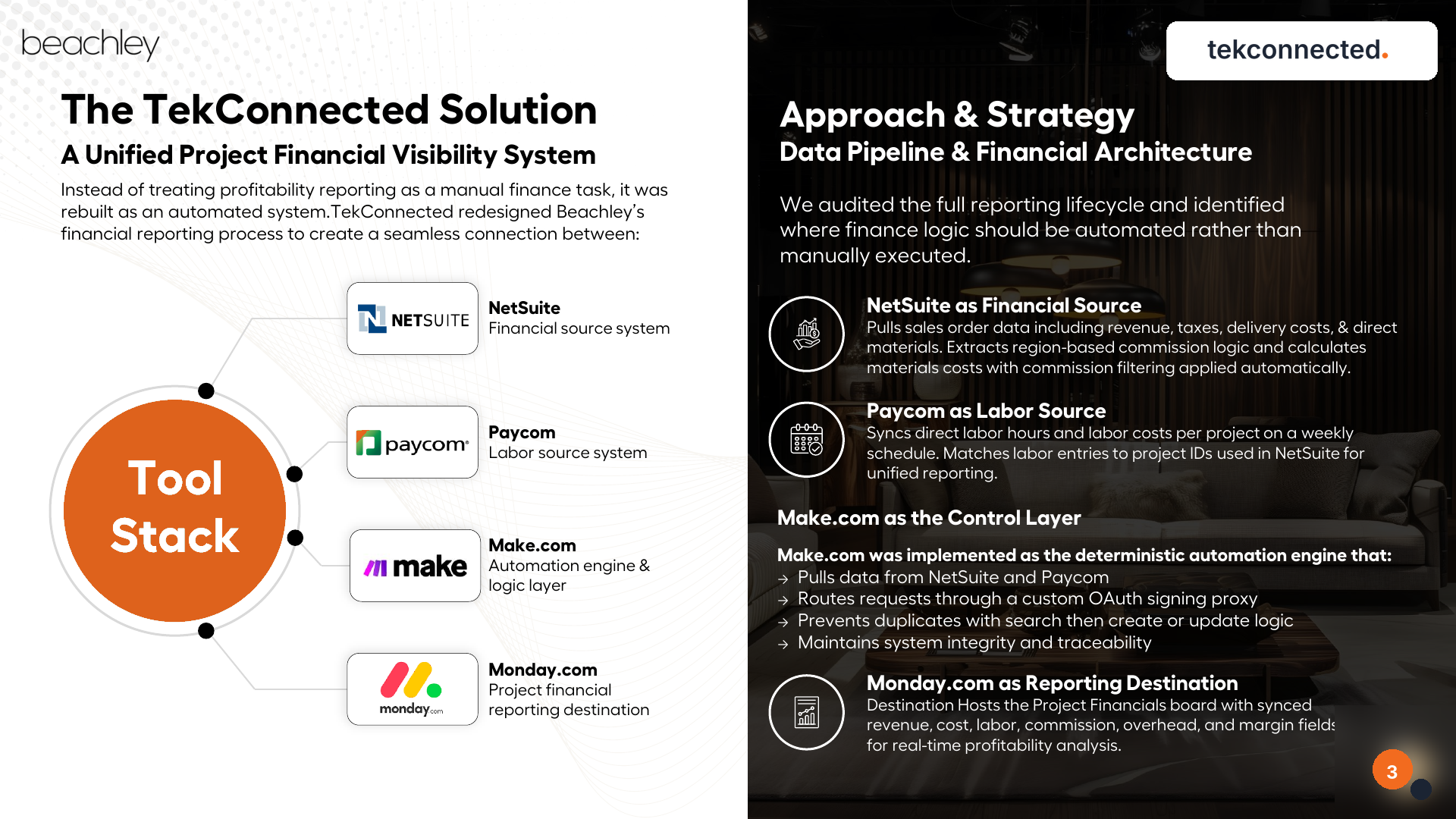
TekConnected redesigned Beachley's financial reporting process into a unified project financial visibility system. Instead of treating profitability reporting as a manual finance task, it was rebuilt as an automated system.
Tool Stack
- NetSuite
- Financial source system.
- Paycom
- Labor source system.
- Make.com
- Automation engine and logic layer.
- Monday.com
- Project financial reporting destination.
Data Pipeline and Financial Architecture
- NetSuite as Financial Source
- Pulls sales order data including revenue, taxes, delivery costs, and direct materials. Extracts region-based commission logic and calculates materials costs with commission filtering applied automatically.
- Paycom as Labor Source
- Syncs direct labor hours and labor costs per project on a weekly schedule. Matches labor entries to project IDs used in NetSuite for unified reporting.
- Monday.com as Reporting Destination
- Hosts the Project Financials board with synced revenue, cost, labor, commission, overhead, and margin fields for real-time profitability analysis.
Make.com as the Control Layer
Make.com was implemented as the deterministic automation engine that:
- Pulls data from NetSuite and Paycom
- Routes requests through a custom OAuth signing proxy
- Prevents duplicates with search-then-create-or-update logic
- Maintains system integrity and traceability
The underlying principle is that financial operations should be system-driven, not admin-driven.
Technology Stack
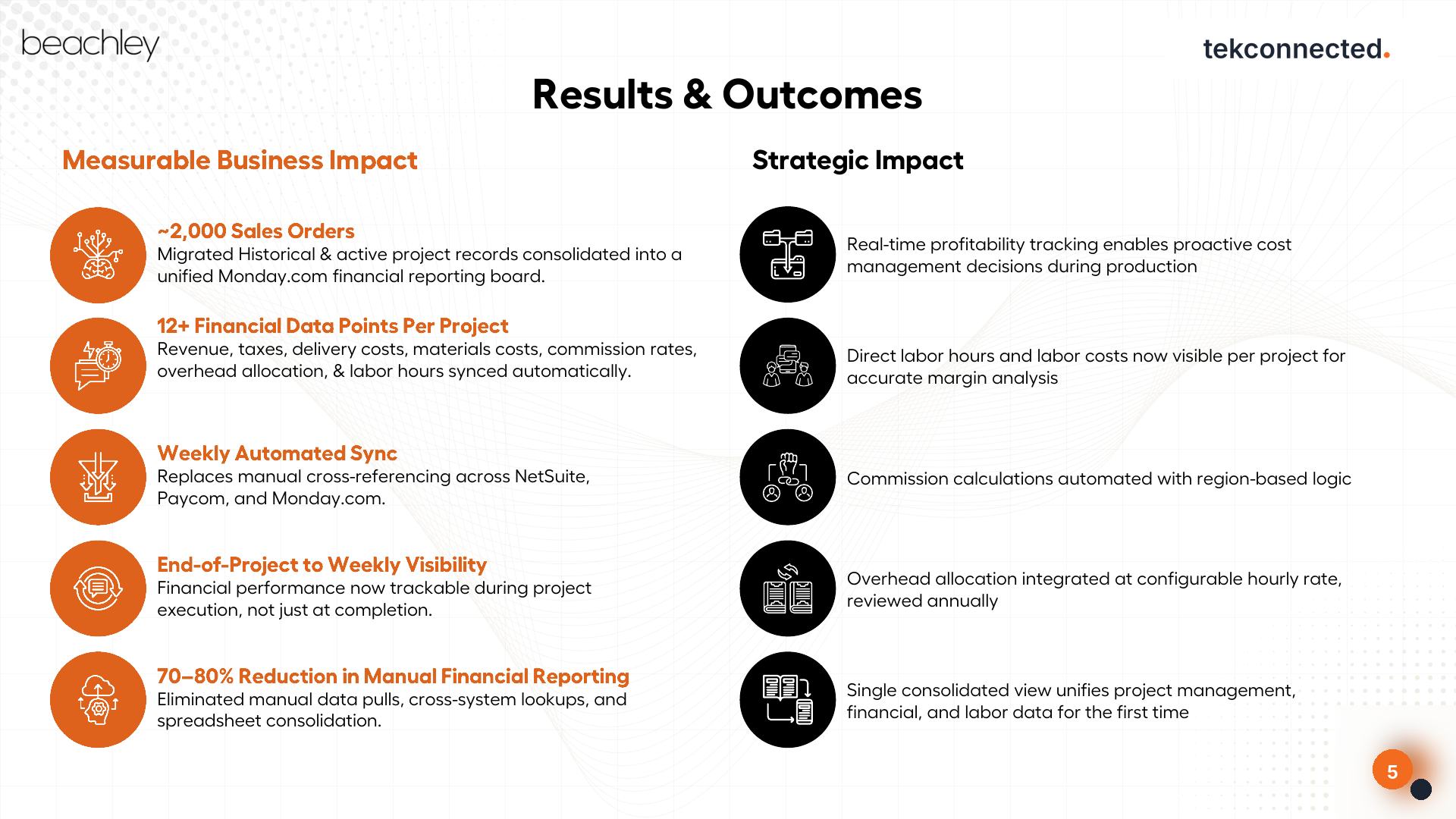
Results & Outcomes
- Approximately 2,000 Sales Orders Migrated
- Historical and active project records consolidated into a unified Monday.com financial reporting board.
- 12+ Financial Data Points Per Project
- Revenue, taxes, delivery costs, materials costs, commission rates, overhead allocation, and labor hours synced automatically.
- Weekly Automated Sync
- Replaces manual cross-referencing across NetSuite, Paycom, and Monday.com.
- End-of-Project to Weekly Visibility
- Financial performance now trackable during project execution, not just at completion.
- 70 to 80% Reduction in Manual Financial Reporting
- Eliminated manual data pulls, cross-system lookups, and spreadsheet consolidation.
Strategic Impact
- Real-time profitability tracking enables proactive cost management decisions during production.
- Direct labor hours and labor costs now visible per project for accurate margin analysis.
- Commission calculations automated with region-based logic.
- Overhead allocation integrated at a configurable hourly rate, reviewed annually.
- A single consolidated view unifies project management, financial, and labor data for the first time.
Who This Applies To
This build pattern fits an organisation that:
- Runs strong systems in isolation with fragmented financial visibility
- Depends on manual reconciliation between ERP, payroll, and project management systems
- Can only assess project profitability after the project closes
- Cannot see labor cost per project without exporting from payroll by hand