AircraftParts.net: A Logbook Intelligence Platform for Aviation Trace Research
The Challenge
AircraftParts.net teams had to search scanned logbooks to locate install and removal events and hours or cycles references. Trace questions delayed quoting and forced sales to wait on internal availability.
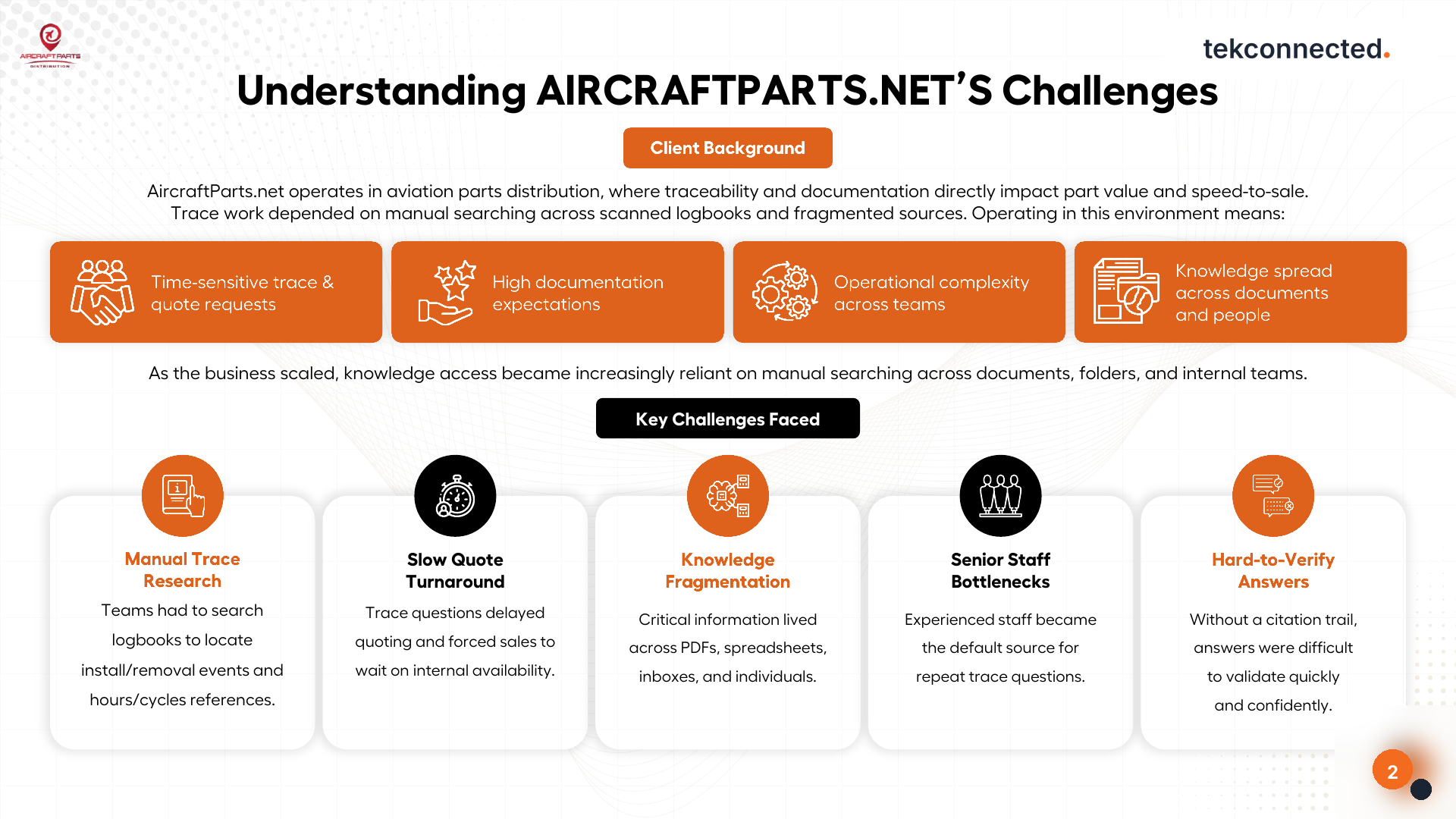
AircraftParts.net operates in aviation parts distribution, where traceability and documentation directly impact part value and speed-to-sale. As the business scaled, knowledge access became increasingly reliant on manual searching across documents, folders, and internal teams.
What Operating in This Environment Means
- Time-sensitive trace and quote requests
- High documentation expectations
- Operational complexity across teams
- Knowledge spread across documents and people
Key Challenges Faced
- Manual Trace Research
- Teams had to search logbooks to locate install and removal events and hours or cycles references.
- Slow Quote Turnaround
- Trace questions delayed quoting and forced sales to wait on internal availability.
- Knowledge Fragmentation
- Critical information lived across PDFs, spreadsheets, inboxes, and individuals.
- Senior Staff Bottlenecks
- Experienced staff became the default source for repeat trace questions.
- Hard-to-Verify Answers
- Without a citation trail, answers were difficult to validate quickly and confidently.
The Solution
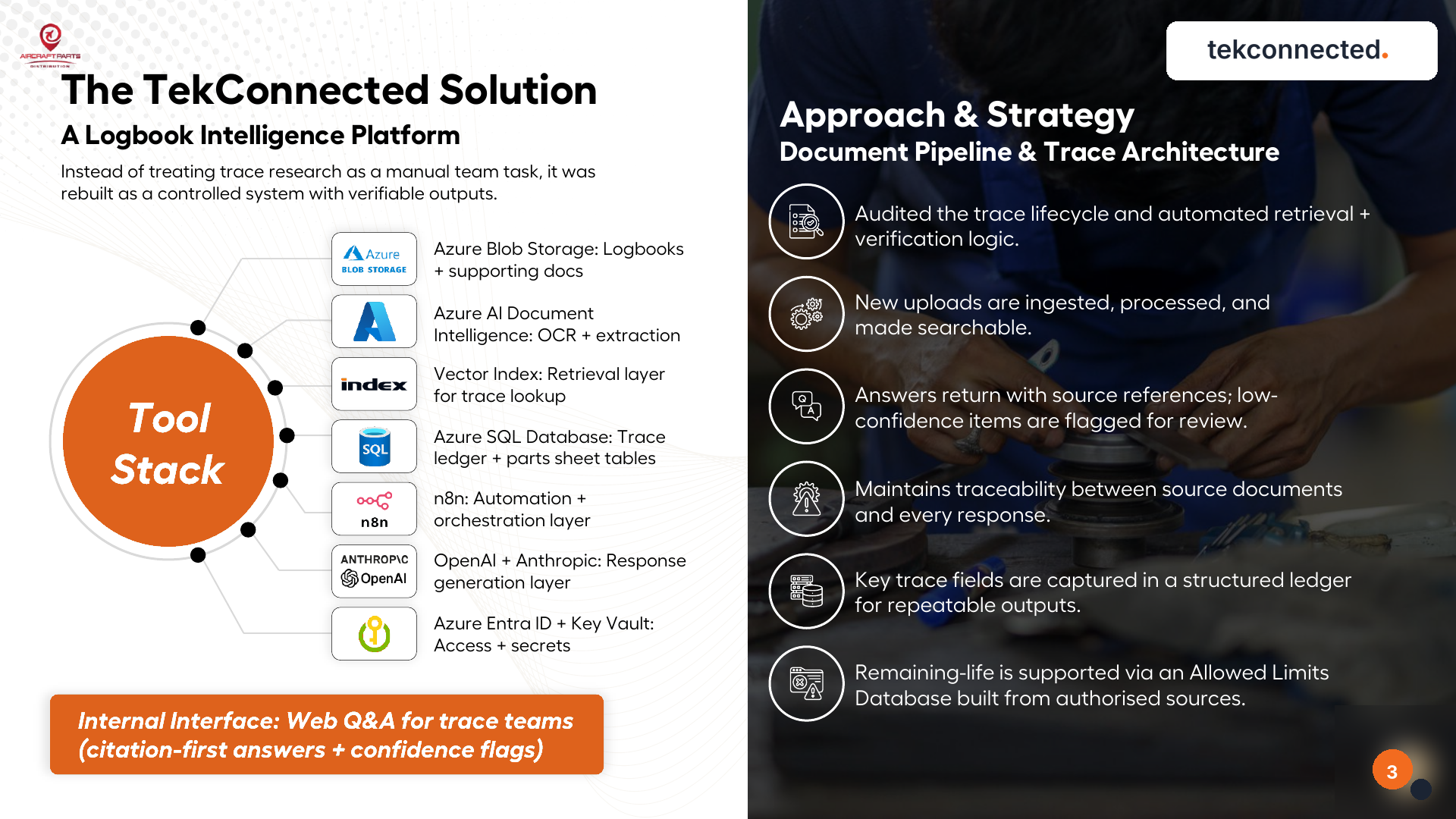
TekConnected built a logbook intelligence platform. Instead of treating trace research as a manual team task, it was rebuilt as a controlled system with verifiable outputs.
Tool Stack
- Azure Blob Storage
- Logbooks and supporting documents.
- Azure AI Document Intelligence
- OCR and extraction.
- Vector Index
- Retrieval layer for trace lookup.
- Azure SQL Database
- Trace ledger and parts sheet tables.
- n8n
- Automation and orchestration layer.
- OpenAI + Anthropic
- Response generation layer.
- Azure Entra ID + Key Vault
- Access and secrets.
The internal interface is a web question-and-answer tool for trace teams, built around citation-first answers with confidence flags.
Document Pipeline and Trace Architecture
- Audited the trace lifecycle and automated retrieval and verification logic
- New uploads are ingested, processed, and made searchable
- Answers return with source references, and low-confidence items are flagged for review
- Maintains traceability between source documents and every response
- Key trace fields are captured in a structured ledger for repeatable outputs
- Remaining-life is supported via an Allowed Limits Database built from authorised sources
Technology Stack
Results & Outcomes
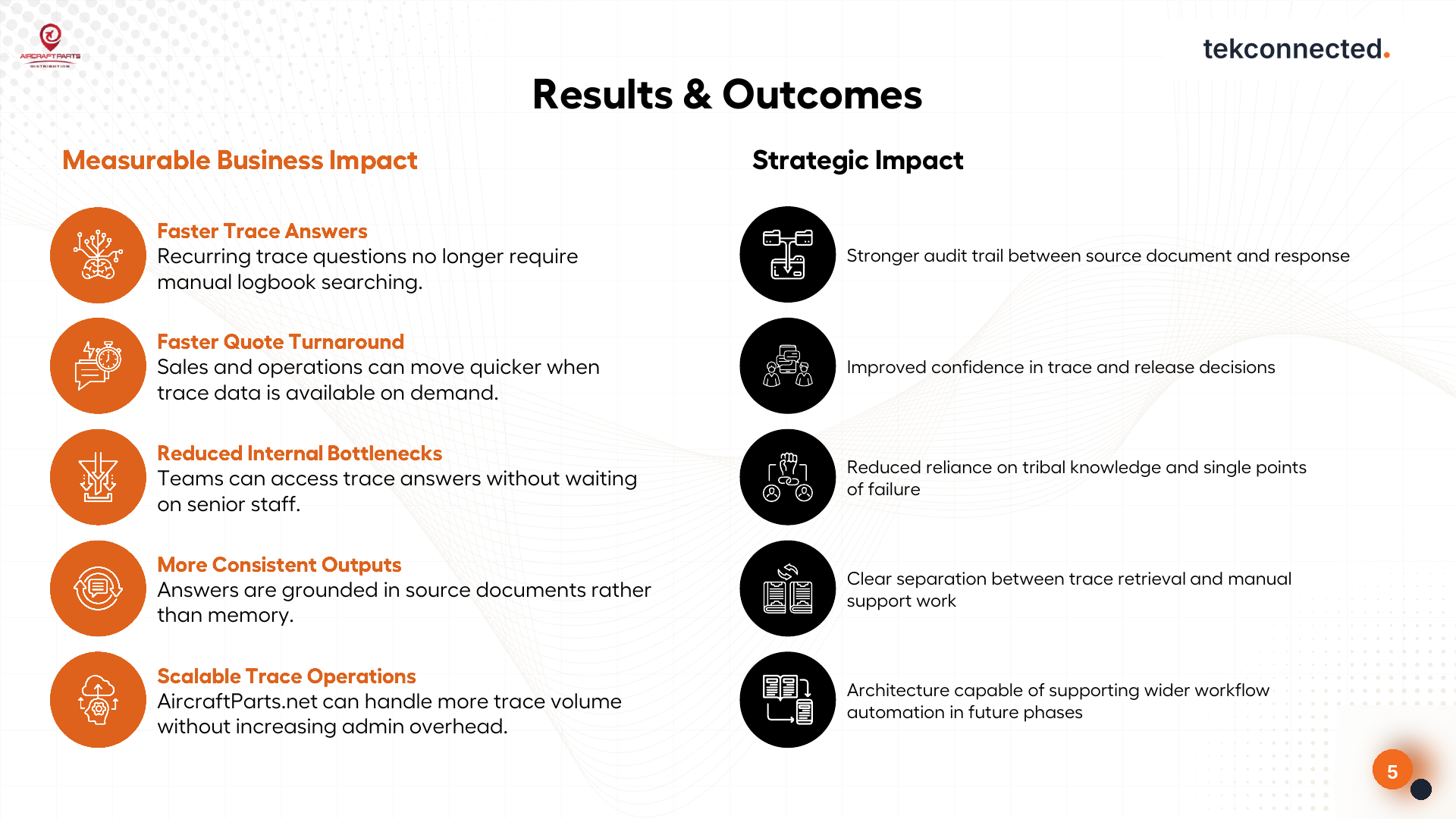
- Faster Trace Answers
- Recurring trace questions no longer require manual logbook searching.
- Faster Quote Turnaround
- Sales and operations can move quicker when trace data is available on demand.
- Reduced Internal Bottlenecks
- Teams can access trace answers without waiting on senior staff.
- More Consistent Outputs
- Answers are grounded in source documents rather than memory.
- Scalable Trace Operations
- AircraftParts.net can handle more trace volume without increasing admin overhead.
Strategic Impact
- Stronger audit trail between source document and response.
- Improved confidence in trace and release decisions.
- Reduced reliance on tribal knowledge and single points of failure.
- Clear separation between trace retrieval and manual support work.
- Architecture capable of supporting wider workflow automation in future phases.
Who This Applies To
This build pattern fits an organisation that:
- Searches scanned documents by hand to answer recurring technical questions
- Delays quoting because the information a sale depends on is not available on demand
- Routes repeat questions to the same few experienced staff
- Cannot validate answers quickly because there is no citation trail back to source