PCMGKC: Automated Invoicing From Project Data to QuickBooks in One Click
The Challenge
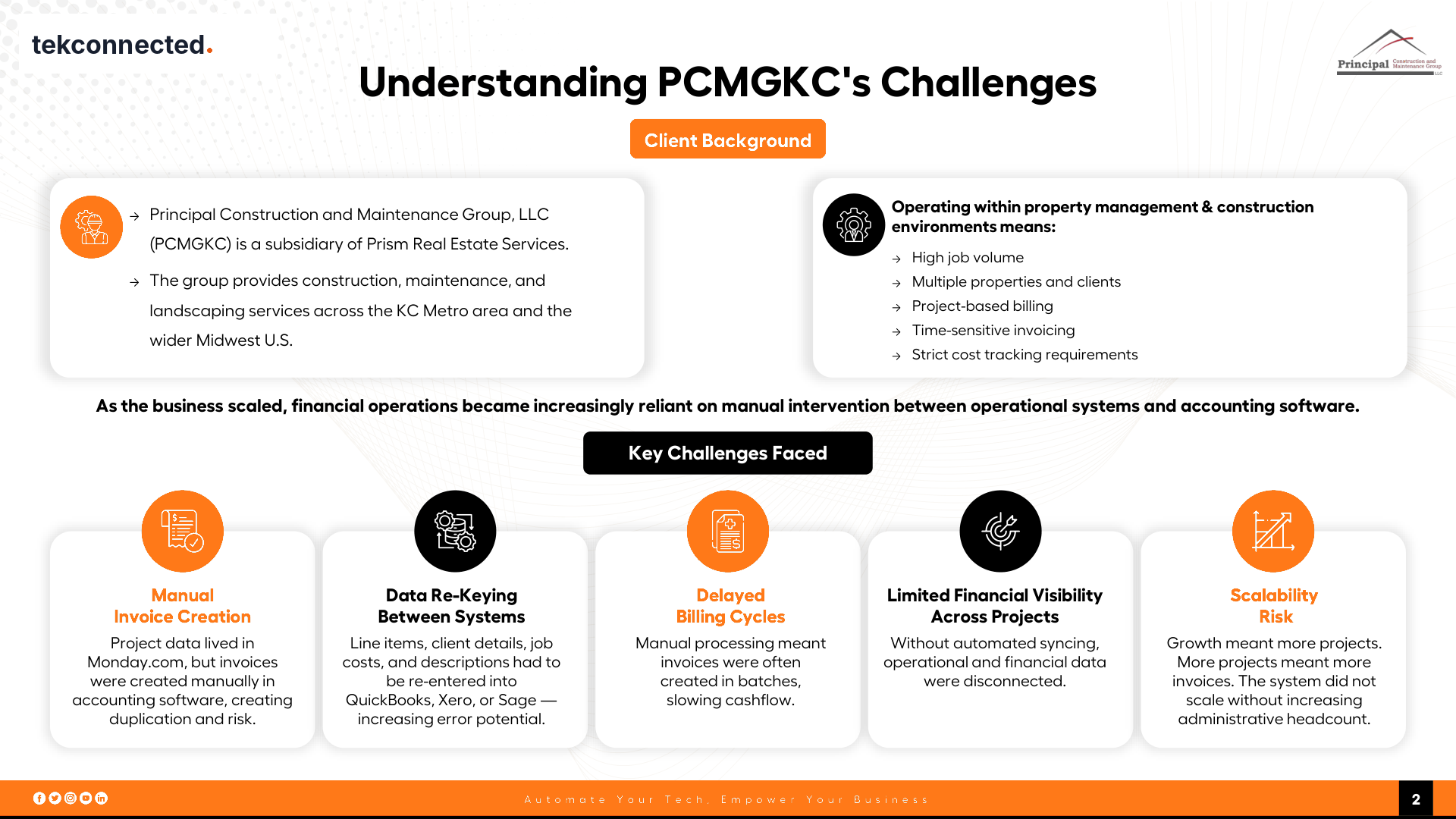
Project data at PCMGKC lived in Monday.com, but invoices were created manually in accounting software, creating duplication and risk. Line items, client details, job costs, and descriptions had to be re-entered into QuickBooks, Xero, or Sage, increasing error potential.
Principal Construction and Maintenance Group, LLC (PCMGKC) is a subsidiary of Prism Real Estate Services, providing construction, maintenance, and landscaping services across the KC Metro area and the wider Midwest U.S. As the business scaled, financial operations became increasingly reliant on manual intervention between operational systems and accounting software.
What Operating in Property Management and Construction Means
- High job volume across multiple properties and clients
- Project-based billing and time-sensitive invoicing
- Strict cost tracking requirements
Key Challenges Faced
- Duplicate Data Entry
- Line items, client details, job costs, and descriptions had to be re-entered into accounting software, increasing error potential.
- Delayed Billing Cycles
- Manual processing meant invoices were often created in batches, slowing cashflow.
- Disconnected Financial Visibility
- Without automated syncing, operational and financial data were disconnected, limiting visibility across projects.
- Scalability Constraints
- Growth meant more projects, and more projects meant more invoices, so the system did not scale without increasing administrative headcount.
The Solution
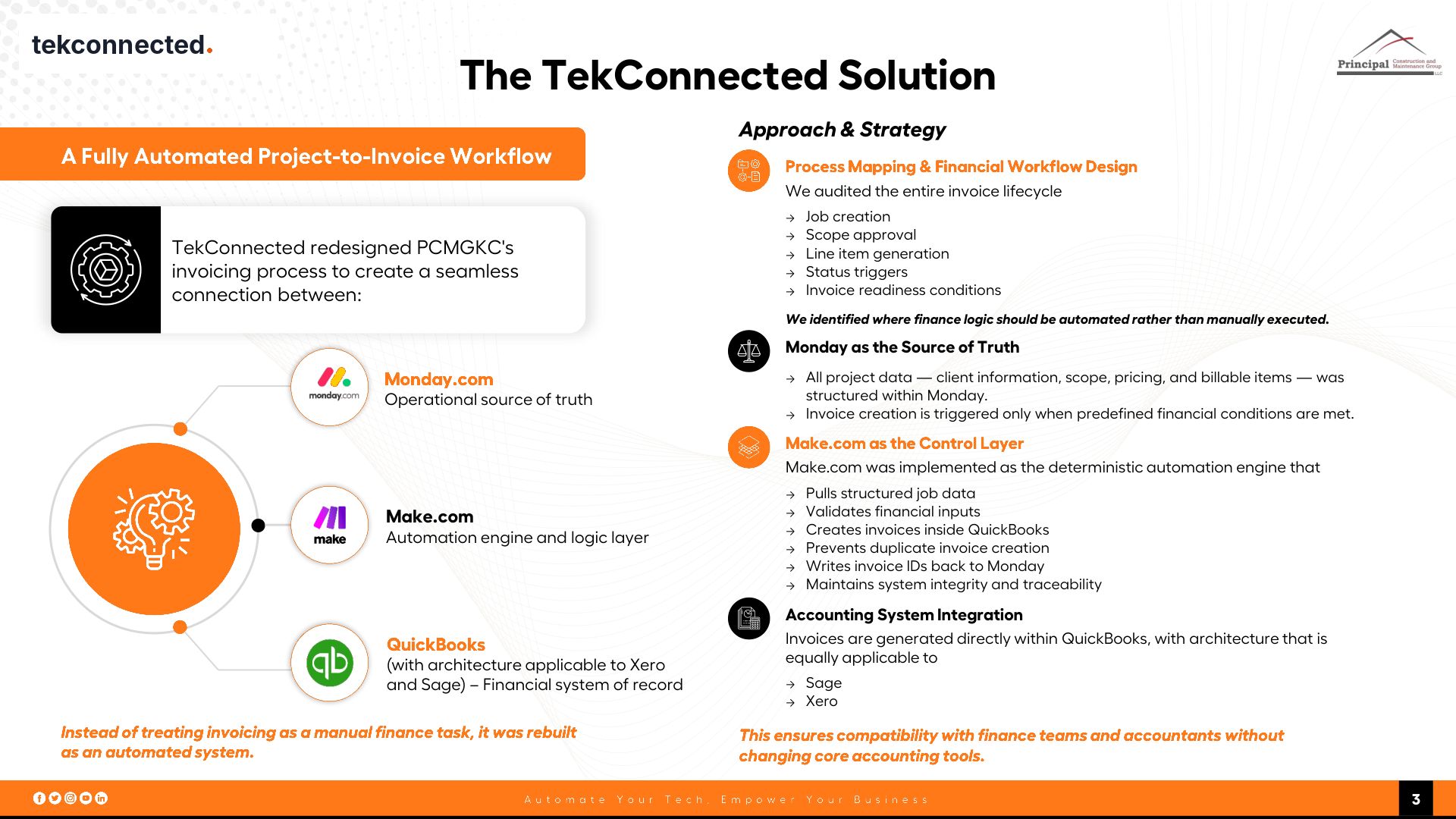
TekConnected redesigned PCMGKC's invoicing process to create a seamless connection between Monday.com, Make.com, and QuickBooks. Instead of treating invoicing as a manual finance task, it was rebuilt as an automated system.
The Three Layers
- Monday.com
- Operational source of truth.
- Make.com
- Automation engine and logic layer.
- QuickBooks
- Financial system of record, with architecture applicable to Xero and Sage.
Process Mapping and Financial Workflow Design
TekConnected audited the entire invoice lifecycle covering job creation, scope approval, line item generation, status triggers, and invoice readiness conditions, identifying where finance logic should be automated rather than manually executed.
Monday as the Source of Truth
- All project data including client information, scope, pricing, and billable items is structured within Monday
- Invoice creation is triggered only when predefined financial conditions are met
Make.com as the Control Layer
Make.com was implemented as the deterministic automation engine that:
- Pulls structured job data
- Validates financial inputs
- Creates invoices inside QuickBooks
- Prevents duplicate invoice creation
- Writes invoice IDs back to Monday
- Maintains system integrity and traceability
Accounting System Integration
Invoices are generated directly within QuickBooks, with architecture that is equally applicable to Sage and Xero. This ensures compatibility with finance teams and accountants without changing core accounting tools. The underlying principle is that financial operations should be system-driven, not admin-driven.
Technology Stack
Results & Outcomes
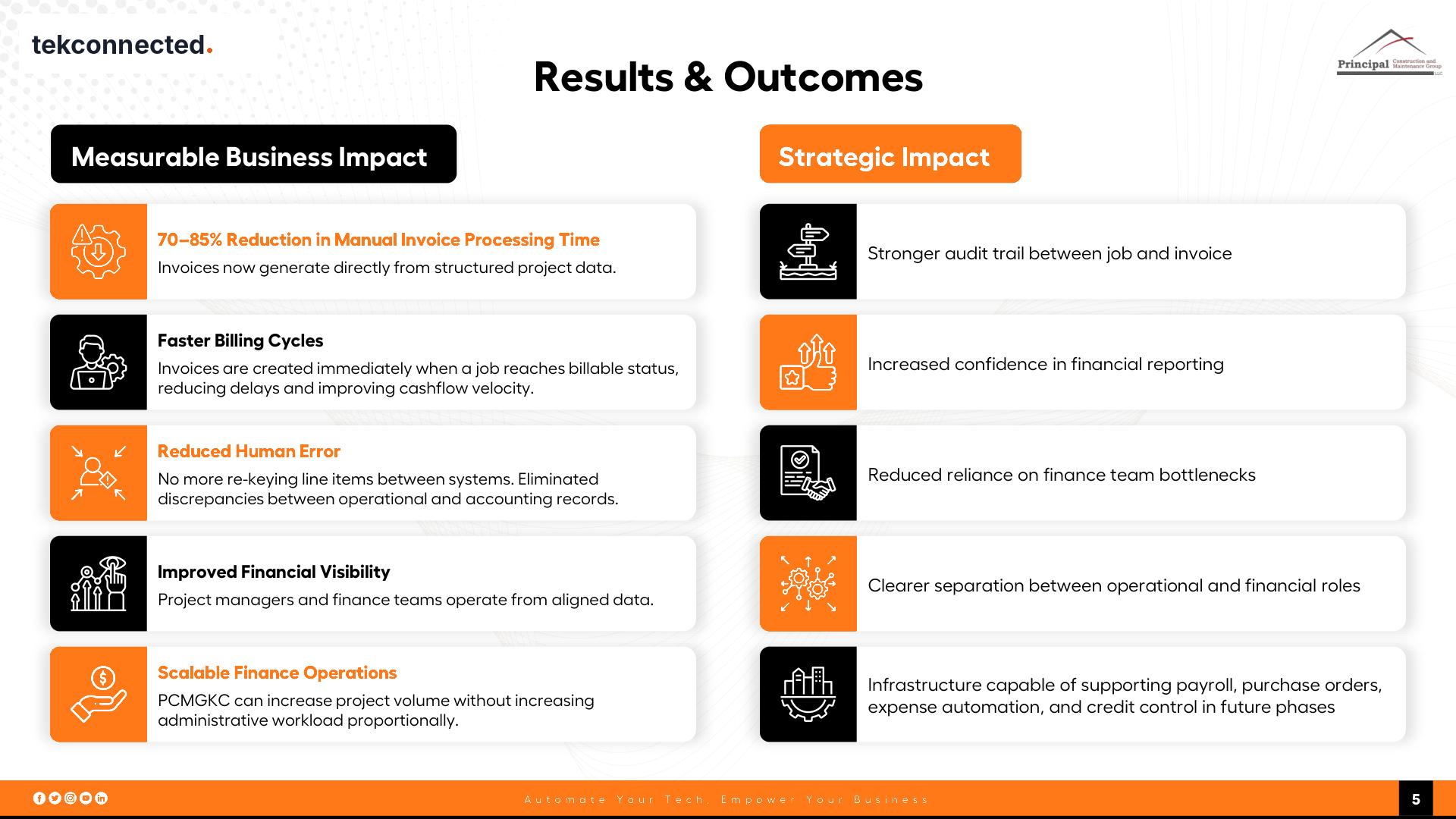
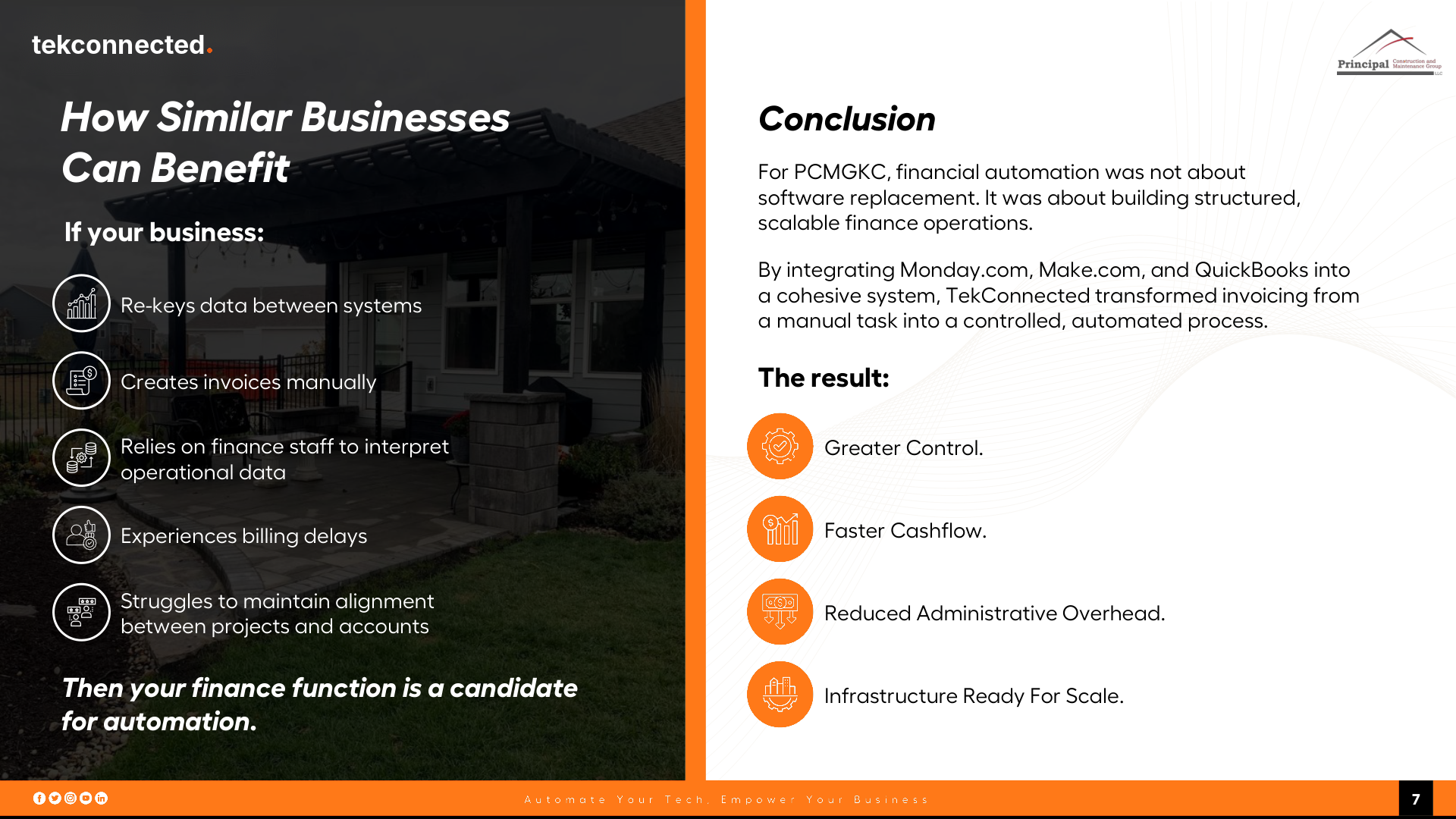
- 70 to 85% Reduction in Manual Invoice Processing Time
- Invoices now generate directly from structured project data.
- Faster Billing Cycles
- Invoices are created immediately when a job reaches billable status, reducing delays and improving cashflow velocity.
- Reduced Human Error
- No more re-keying line items between systems, eliminating discrepancies between operational and accounting records.
- Improved Financial Visibility
- Project managers and finance teams operate from aligned data.
- Scalable Finance Operations
- PCMGKC can increase project volume without increasing administrative workload proportionally.
Strategic Impact
- Stronger audit trail between job and invoice.
- Increased confidence in financial reporting.
- Reduced reliance on finance team bottlenecks.
- Clearer separation between operational and financial roles.
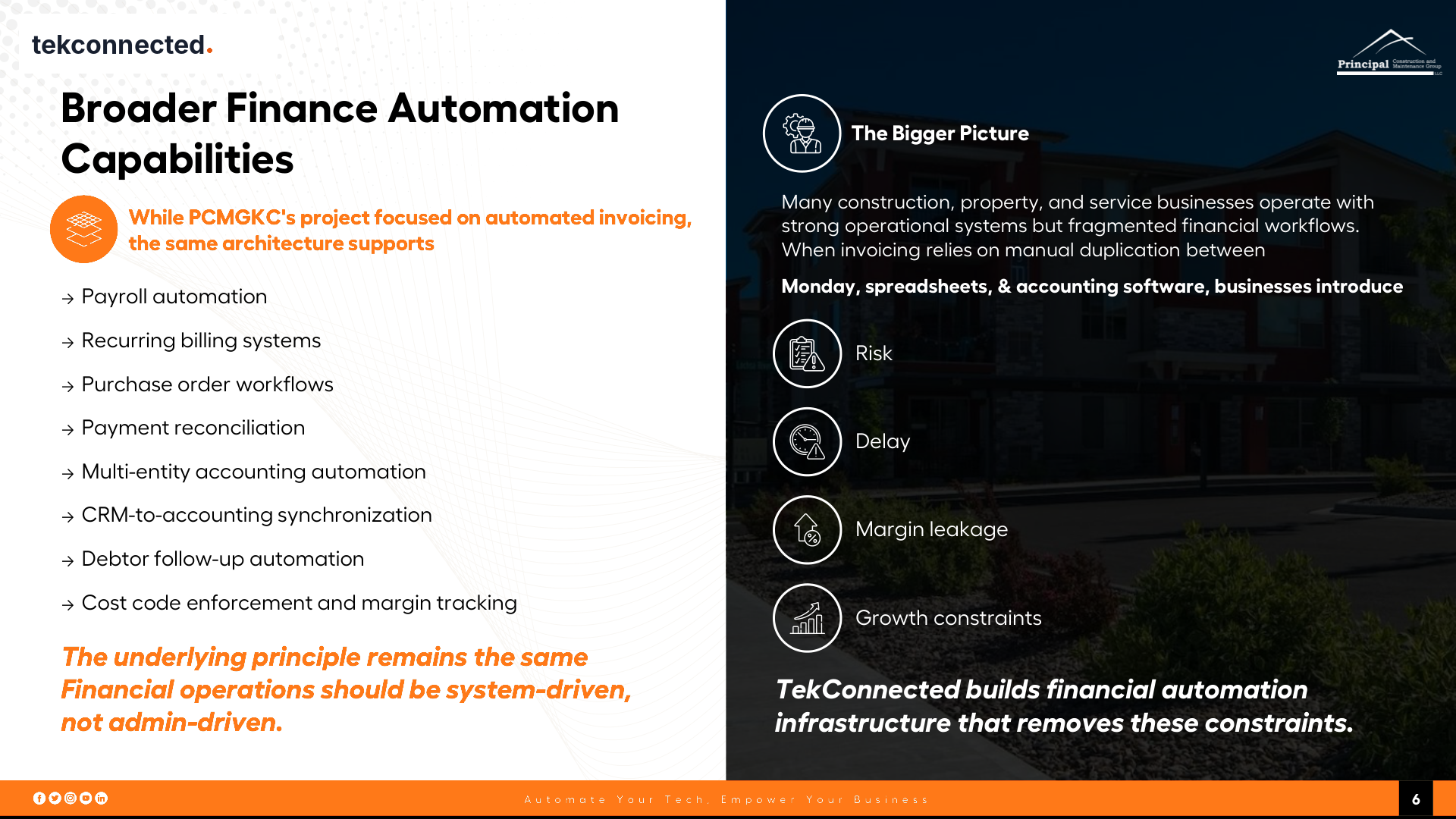
- Infrastructure capable of supporting payroll, purchase orders, expense automation, and credit control in future phases.
Who This Applies To
This build pattern fits an organisation that:
- Runs strong operational systems alongside fragmented financial workflows
- Duplicates invoicing manually between Monday.com, spreadsheets, and accounting software
- Delays billing because invoices are created in batches
- Cannot add project volume without adding administrative headcount